

Introduction
Not every asset label should be made from the same material.
A label applied to an office laptop has very different requirements from a tag attached to industrial machinery, outdoor equipment or a chemical-exposed surface.
That is why choosing Asset Labels should begin with the application environment rather than simply selecting a size and printing an asset number.
The right material needs to match:
- The surface
- Expected lifespan
- Temperature
- Moisture exposure
- Chemicals
- Abrasion
- Outdoor conditions
- Security requirements
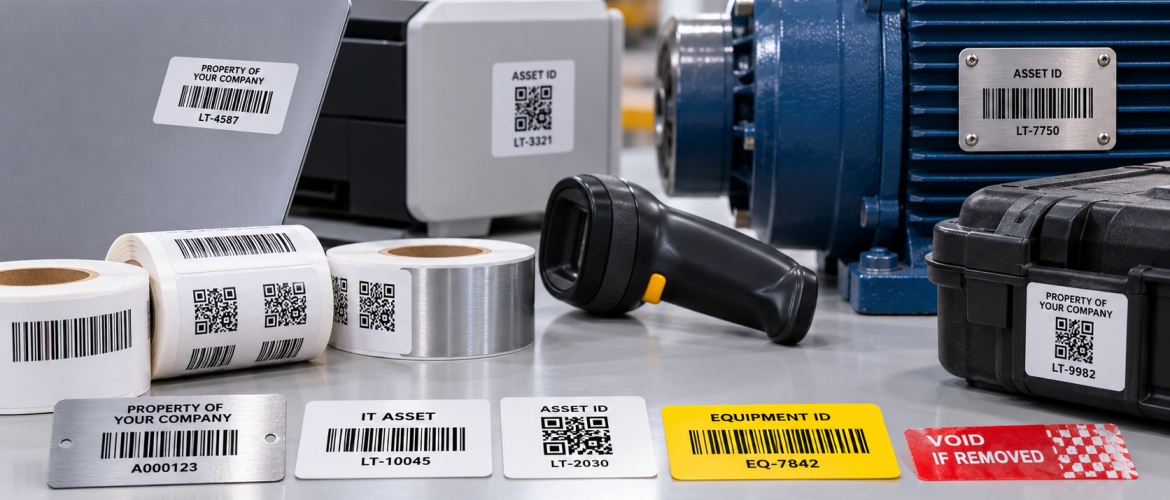
Label Tech currently offers asset-tag materials including polyester, metal and tamper-evident formats for different operating conditions. Label Tech UAE
You can explore asset tags and asset labels for different asset identification and tracking requirements.
Why Asset Label Material Matters
An asset label is only useful if it remains readable and attached for the required period.
Poor material selection can lead to:
- Peeling
- Fading
- Damaged barcodes
- Unreadable serial numbers
- Missing asset identification
- Extra re-labelling work
The label should therefore be selected according to the physical environment where the asset will actually be used.
Asset Labels for Metal Surfaces
Metal surfaces are common on:
- Machinery
- Cabinets
- Tools
- Industrial equipment
- Electrical enclosures
- Racking
For these applications, the label needs an adhesive suitable for smooth or coated metal.
For long-term or demanding use, a rigid metal tag may also be appropriate.
Label Tech lists anodized aluminium asset tags for harsher conditions where stronger resistance to weather and chemicals is required. Label Tech UAE
Asset Labels for Plastic Equipment
Plastic surfaces are common on:
- Laptops
- Printers
- Monitors
- Telephones
- Electronics
- Office equipment
The challenge is that plastics can have different surface textures and chemical compositions.
Before ordering, businesses should test the adhesive on the actual equipment.
Important questions include:
- Is the surface smooth or textured?
- Will the label be applied to a curved section?
- Will the equipment become warm?
- Does the surface contain coatings that affect adhesion?
Asset Labels for Electronics
Electronics often require compact labels with clear human-readable text and machine-readable data.
Typical information may include:
- Asset ID
- Barcode
- QR code
- Company name
- Serial reference
For devices such as laptops and monitors, label placement should avoid:
- Ventilation areas
- Hinges
- Frequently handled surfaces
- Removable covers
Consistency in placement can also make audits faster.
Asset Labels for Outdoor Equipment
Outdoor assets face additional conditions such as:
- Sunlight
- Heat
- Moisture
- Dust
- Rain
- Cleaning
- Temperature variation
A general indoor label may not provide sufficient durability.
Outdoor asset labels should be selected specifically for exposure conditions and required service life.
Label Tech states that some polyester asset labels are suitable for indoor and outdoor applications, while its metal tags are intended for more demanding environments. Label Tech UAE
Asset Labels for Harsh Industrial Environments
Industrial assets may be exposed to:
- Chemicals
- Oils
- Abrasion
- Cleaning agents
- Heat
- Dust
- Continuous handling
In such situations, durability should take priority over appearance.
A paper label that works well in an office may fail quickly in a workshop or plant environment.
Permanent Polyester Asset Labels
Polyester labels are commonly used where businesses need a durable adhesive label.
Typical applications can include:
- IT equipment
- Furniture
- Office equipment
- General industrial assets
Advantages can include:
- Clean appearance
- Barcode compatibility
- Variable-data printing
- Resistance to normal handling
The exact specification still depends on the application.
Metal Asset Tags
Metal tags can be a better choice where long-term durability is required.
They can be suitable for:
- Heavy machinery
- Outdoor equipment
- Industrial installations
- Assets exposed to chemicals
- Long-life equipment
They are particularly useful when a thin adhesive label may not provide sufficient physical durability.
Tamper-Evident Asset Labels
Some organizations need labels that show visible evidence if removal is attempted.
These may be useful for:
- Electronics
- Warranty-controlled items
- Sensitive equipment
- IT assets
- Restricted devices
Label Tech offers tamper-evident formats including VOID and destructible materials. Label Tech UAE
Paper Asset Labels
Paper labels may be suitable for lower-risk indoor applications where:
- The asset is not exposed to moisture
- Long-term durability is not critical
- The environment is controlled
They are generally not the best option for demanding industrial or outdoor conditions.
Explore printed labels for different labeling and product identification applications.
How Surface Texture Affects Adhesion
The smoother the surface, the easier it usually is for an adhesive label to achieve full contact.
Textured or uneven surfaces can reduce adhesive contact.
Before placing a large order:
- Clean the actual surface.
- Apply a sample label.
- Leave it for an appropriate period.
- Test adhesion.
- Check edge lifting.
- Confirm barcode readability.
Curved Surfaces
Labels applied to curved surfaces need to be flexible enough to remain attached.
A stiff material may lift at the edges when wrapped around a tight radius.
This is especially important for:
- Cylindrical tools
- Pipes
- Curved housings
- Small equipment
Temperature Considerations
Temperature affects both label material and adhesive.
Businesses should consider:
- Application temperature
- Normal operating temperature
- Short-term heat exposure
- Cold-storage conditions
- Outdoor temperature changes
The temperature when the label is applied can also matter.
Chemical Resistance
Assets in laboratories, workshops or factories may come into contact with:
- Solvents
- Cleaning chemicals
- Lubricants
- Oils
- Industrial fluids
If this is likely, businesses should confirm resistance before production.
Barcode and QR Code Readability
Material selection should not reduce scan performance.
The finished label should provide:
- Good contrast
- Clean printing
- Suitable barcode size
- Flat application
- Minimal surface damage
Glossy or reflective surfaces should also be tested with the intended scanner.
You can explore barcode printing services for barcode label printing and identification requirements.
Choosing Between Barcode and QR Asset Labels
Barcode Labels
Useful where businesses already use conventional barcode scanners.
Explore barcode scanners for barcode reading and asset-tracking applications.
QR Code Labels
Can support applications where users need to access information through compatible mobile devices.
The decision should be based on the existing asset-management workflow.
You can explore handheld PDA devices for mobile barcode scanning, inventory management and asset-tracking workflows.
Asset Label Selection Checklist
Before ordering, confirm:
- Asset surface
- Indoor or outdoor use
- Required lifespan
- Temperature
- Moisture
- Chemical exposure
- Abrasion
- Security requirement
- Barcode or QR format
- Label size
- Adhesive performance
- Required quantity
Sample Testing Before Production
Sample testing is one of the most important steps.
Apply the proposed label to the real equipment.
Then check:
- Adhesion
- Readability
- Scanning
- Appearance
- Edge lifting
- Surface compatibility
This can help avoid producing hundreds or thousands of unsuitable labels.
Conclusion
Choosing the right Asset Labels starts with understanding the surface and environment.
Office electronics, outdoor equipment and industrial machinery should not automatically use the same material.
Polyester labels can suit many general applications, while metal tags may be better for harsh or long-term environments. Tamper-evident materials can support security-sensitive applications.
A material-first approach can improve label life, readability and asset-management consistency.
For custom asset labels and asset identification requirements, contact Label Tech UAE to discuss your requirements.
Frequently Asked Questions
Which material is best for asset labels?
There is no single best material. The choice depends on surface type, environment, required lifespan and security requirements.
Are polyester asset labels durable?
They can be suitable for many indoor and outdoor applications, depending on the exact material and adhesive.
When should I use metal asset tags?
Metal tags can be useful for harsh industrial conditions, outdoor assets and long-life equipment.
Can asset labels stick to plastic?
Yes, but adhesion should be tested because different plastics have different surface characteristics.
Can asset labels be used outdoors?
Yes, provided the selected material and adhesive are designed for outdoor exposure.
Are tamper-evident asset labels available?
Yes. VOID and destructible materials can provide visible evidence of attempted removal.
