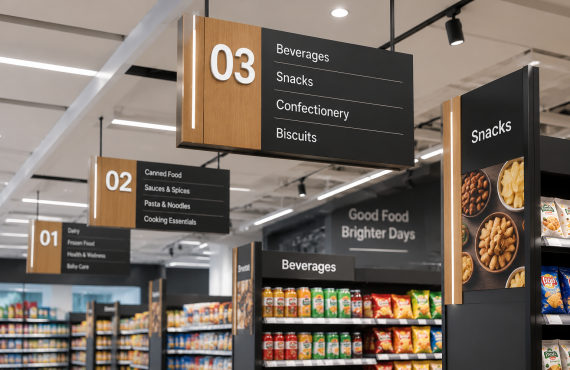

Warehouses, factories and distribution centres depend on clear identification systems to keep products, employees and vehicles moving efficiently. When storage areas are poorly marked, workers may spend unnecessary time searching for locations, inventory may be placed in the wrong area and material-handling equipment may follow incorrect routes.
Aisle boards provide visible location references throughout a facility. They help employees identify warehouse zones, aisles, racks and storage sections from a distance. When combined with rack and shelf labels, aisle boards create a structured warehouse identification system that supports faster and more accurate operations.
What Are Aisle Boards?
Aisle boards are signs installed at the beginning, end or intersection of warehouse aisles. They normally display letters, numbers, colour codes, arrows or other location information.
Depending on the facility layout, aisle boards may be:
- Fixed directly to racks
- Suspended from ceilings
- Mounted above entrances
- Installed perpendicular to the aisle
- Printed on one or both sides
- Colour coded according to zones
- Combined with directional arrows
The purpose is to ensure that employees and equipment operators can recognise each aisle without having to approach individual shelf labels.
Why Aisle Identification Matters
A warehouse may contain hundreds or thousands of storage locations. Without a consistent identification system, locating a specific product can become slow and confusing.
Aisle boards provide the first level of navigation. Once the correct aisle is identified, rack, bay, level and shelf labels guide the worker to the exact storage location.
This structured approach can support:
- Faster product picking
- More accurate stock placement
- Easier employee training
- Improved warehouse navigation
- Better inventory control
- Clearer vehicle routes
- Reduced location errors
- More organised storage areas
Aisle identification becomes especially important in large facilities where employees, forklifts, pallet trucks and other equipment move continuously.
Aisle Boards and Warehouse Safety
Warehouse signage contributes to a clearer working environment. Large, readable aisle boards help operators identify their destination before entering an aisle.
Directional signage can also be used to indicate movement routes, receiving areas, dispatch zones, storage sections and restricted locations.
However, aisle boards should not replace mandatory safety signs. They should form part of a broader facility signage system that may include emergency exits, fire equipment signs, speed limits, pedestrian routes and hazard warnings.
The design should remain simple and easy to interpret. Too much information on one sign can make it difficult to read, particularly from a moving vehicle.
Choosing the Right Aisle Board Design
An effective aisle board should be visible from the expected viewing distance.
Important design considerations include:
Letter and Number Size
The text should be large enough to read from the main travel route. The required size will depend on mounting height and viewing distance.
Colour Contrast
Dark text on a light background or light text on a dark background generally provides better readability. Colour coding may also be used to separate warehouse zones.
One-Sided or Two-Sided Printing
A two-sided aisle board can be read from both directions. This is useful when employees or vehicles approach the aisle from different sides.
Directional Arrows
Arrows help guide workers towards numbered aisles, storage zones, loading areas or specific departments.
Consistent Numbering
The aisle numbering system should follow a clear sequence. Random or inconsistent codes may create confusion even when the signs are visually clear.
Materials for Warehouse Aisle Boards
The selected material should suit the warehouse environment and installation method.
Lightweight board materials may be suitable for suspended indoor signs. More durable materials may be required in areas exposed to dust, heat, moisture or frequent contact.
The supplier should also consider whether the signs need to be cleaned regularly and whether forklifts or stored goods may come into contact with them.
Printing should remain visible throughout the expected lifespan of the board. Protective finishes may be considered when signs will be exposed to demanding conditions.
Combining Aisle Boards With Rack and Shelf Labels
Aisle boards work best as part of a complete warehouse labelling structure.
A typical location code may include:
- Warehouse zone
- Aisle number
- Rack or bay number
- Shelf level
- Individual bin or position
For example, a code such as B-12-04-03 may identify Zone B, Aisle 12, Bay 4 and Level 3.
Aisle boards direct employees to the correct general area, while rack and shelf labels guide them to the exact location. Barcode labels can then support scanning and digital inventory updates.
Label Tech’s current rack-label service includes data generation, label printing, application, aisle-board printing and fixing for warehouses and related facilities.
Industries That Use Aisle Boards
Aisle boards are commonly used in:
- Warehouses
- Logistics centres
- Distribution facilities
- Manufacturing plants
- Hypermarkets
- Cold-storage facilities
- Spare-parts stores
- Pharmaceutical storage areas
- E-commerce fulfilment centres
- Industrial stockrooms
Every facility has a different layout, which means sign dimensions, coding systems and installation methods should be planned according to the available space.
Planning an Aisle Board Project
Before production begins, the warehouse team should review the full facility layout.
Start by identifying all aisles, zones and storage areas. Confirm the direction from which employees normally approach each aisle. Measure the available mounting locations and decide whether signs should be fixed, hanging or suspended.
The warehouse should also confirm the required colours, fonts, codes and arrows. Preparing an approved location list before printing reduces the chance of missing or duplicated signs.
For larger projects, creating and approving a sample board can help confirm readability, colours and size.
Why Custom Aisle Boards Are Better Than Generic Signs
Generic signs may not match the warehouse layout, coding structure or viewing distance. Custom aisle boards allow businesses to select the exact:
- Sign dimensions
- Text size
- Numbering format
- Colour system
- Material
- Mounting method
- Single-sided or double-sided layout
- Directional information
Customisation creates a more consistent system and makes future expansion easier. New signs can follow the same design when racks or warehouse zones are added.
Conclusion
Aisle boards are an essential component of organised warehouse navigation. They help employees locate storage areas, support faster picking and create a clearer environment for workers and material-handling equipment.
The most effective system combines visible aisle boards with properly designed rack, shelf, bay and barcode labels. Careful planning of the numbering structure, sign size, colours and installation positions can improve the usability of the entire warehouse.
Learn more about Label Tech UAE’s rack labels and aisle boards or request a customised warehouse-labelling quotation.