

Introduction
Warehouses, distribution centers, manufacturing facilities and logistics operations depend on organized storage systems. As the size of a facility increases, finding products quickly and accurately becomes more challenging. Employees may need to navigate hundreds of racks, shelves, storage areas and inventory locations every day.
A clear warehouse identification system can make this process easier.
Aisle Boards are an important part of warehouse signage and location identification. They provide highly visible references that help employees identify aisles, zones and storage sections from a distance. When aisle boards are combined with rack labels, shelf labels, bay numbers and barcode labels, they can create a structured warehouse navigation system.
For businesses operating in Dubai and across the UAE, properly planned aisle identification can support faster warehouse navigation, easier stock picking and better organization.
Label Tech UAE provides rack labeling solutions that include data generation, label printing, aisle board printing and fixing for warehouse and storage applications. Its website identifies rack labels and aisle boards as one of its core labeling solutions.
What Are Aisle Boards?
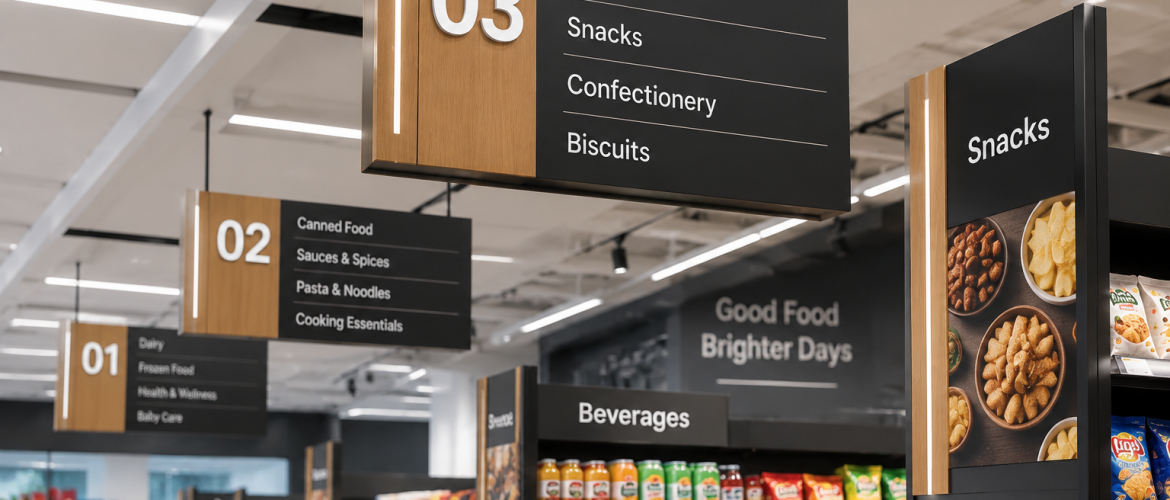
Aisle boards are large, highly visible signs used to identify warehouse aisles, storage zones or specific sections of a facility.
They are usually positioned where workers or forklift operators can see them before entering an aisle.
Depending on the warehouse layout, aisle boards may be:
- Mounted directly onto racks
- Suspended from ceilings
- Installed above aisle entrances
- Fixed perpendicular to the aisle
- Printed on one or both sides
- Color coded
- Designed with directional arrows
- Combined with letters or numbers
The primary objective is simple: make warehouse locations easy to identify from a distance.
Instead of approaching every rack to determine its location, workers can identify the correct aisle first and then use more detailed labels to find the exact storage position.
Why Aisle Identification Is Important
A large warehouse can contain thousands of individual storage locations.
Without a logical identification system, employees may spend unnecessary time searching for products or returning stock to the wrong location.
Aisle boards provide the first level of navigation.
A typical warehouse identification system might work like this:
Aisle Board → Rack Number → Bay Number → Level → Bin/Shelf → Product
For example, a location code might identify:
- Zone B
- Aisle 12
- Bay 04
- Level 03
This structured approach allows employees to understand where they need to go before they begin searching individual storage positions.
Benefits of Using Aisle Boards
1. Faster Warehouse Navigation
Large signs allow employees to identify aisles without walking deep into the warehouse.
This can be particularly useful in facilities with long aisles and high rack systems.
2. Improved Picking Efficiency
When workers can quickly identify the correct aisle, they can spend more time locating the actual product rather than searching for the correct area.
3. Easier Employee Training
New employees can understand warehouse layouts more easily when locations follow a consistent numbering or lettering system.
4. Better Inventory Organization
Clear location identification helps warehouse teams maintain consistent storage practices.
5. Reduced Location Errors
When every aisle, rack and bay has a clear reference, there is less room for confusion.
6. Better Visibility
Large aisle boards are visible from greater distances than small rack labels.
Aisle Boards and Rack Labels: What’s the Difference?
Aisle boards and rack labels perform different but complementary functions.
Aisle Boards
Aisle boards identify the general warehouse location.
They may display:
- Aisle number
- Zone name
- Department
- Directional arrow
- Color code
Rack Labels
Rack labels identify specific storage positions.
They may include:
- Rack number
- Bay number
- Level
- Barcode
- Location code
Label Tech explains that its rack-labeling projects can include data generation, label printing, pasting, aisle board printing and fixing.
This combination creates a more complete warehouse navigation system.
Designing Effective Aisle Boards
A good aisle board should be designed for the actual warehouse environment.
Large and Readable Text
Text needs to be visible from the expected viewing distance.
A sign that looks clear when viewed from two meters away may not be suitable when forklift operators need to identify it from much farther away.
Strong Contrast
Good contrast between the background and text helps improve readability.
Simple Information
Avoid putting too much information on one board.
The purpose of an aisle board is quick identification.
Consistent Numbering
Aisles should follow a logical sequence.
For example:
A01
A02
A03
A04
or:
B01
B02
B03
B04
A consistent structure is easier to remember and maintain.
Directional Arrows
Arrows can help employees identify the direction of a particular warehouse section.
Single-Sided vs Double-Sided Aisle Board
The warehouse layout determines whether a single-sided or double-sided sign is more appropriate.
Single-Sided
Single-sided signs can work when the sign is viewed primarily from one direction.
Double-Sided
Double-sided aisle boards can be useful when workers and equipment approach aisles from both directions.
The installation position should be considered before deciding on the format.
Choosing the Right Material
The material used for an aisle board should reflect the warehouse environment.
Consider:
- Indoor or outdoor installation
- Dust exposure
- Moisture
- Temperature
- Cleaning requirements
- Impact risk
- Installation method
- Expected service life
Indoor storage facilities may have different requirements from warehouses exposed to outdoor conditions.
For demanding environments, businesses should discuss suitable materials and protective finishes with the signage supplier.
Color Coding Aisle Boards
Color coding can make warehouse navigation even easier.
For example:
- Blue = Finished Goods
- Green = Raw Materials
- Yellow = Dispatch
- Red = Restricted Area
The actual color system should be based on the company’s operational requirements.
The most important consideration is consistency.
If blue means one thing in one section and something completely different elsewhere, the color system may create confusion instead of reducing it.
Aisle Boards for Different Industries
Aisle boards can be used in many environments.
Logistics Warehouses
Large logistics facilities often contain large numbers of aisles and storage positions.
E-Commerce Fulfillment Centers
Fast order processing requires employees to locate products quickly.
Manufacturing Plants
Aisle boards can identify raw material, production, finished goods and dispatch areas.
Retail Distribution Centers
Large retail storage facilities can use aisle boards to organize inventory.
Cold Storage
Cold-storage facilities can use durable signage to identify aisles and storage zones.
Spare Parts Warehouses
Aisle identification can be particularly useful when many small components are stored across multiple racks.
Pharmaceutical Storage
Clearly structured locations can support organized inventory management.
How Aisle Boards Support Inventory Management
Aisle boards do not directly manage inventory, but they support the physical organization required for effective inventory management.
Consider a warehouse management system that assigns products to specific locations.
If the system says a product is stored at:
A-07-04-02
the warehouse employee needs to physically identify:
- Aisle A-07
- Bay 04
- Level 02
The aisle board provides the first visual reference.
Rack and shelf labels then complete the identification process.
Barcode systems can provide another layer of accuracy by allowing employees to scan locations and products.
Label Tech also provides barcode-related products and services, including barcode scanners, barcode printers and barcode printing solutions.
Planning an Aisle Board Project
Before printing, warehouse managers should prepare a complete location list.
Step 1: Map the Warehouse
Identify every aisle, zone and storage section.
Step 2: Create a Numbering System
Choose letters, numbers or a combination.
Step 3: Confirm Viewing Directions
Determine how employees and forklifts approach each aisle.
Step 4: Measure Installation Locations
Check mounting height and available space.
Step 5: Select Material
Choose material according to the environment.
Step 6: Approve a Sample
A physical sample can help confirm visibility and readability.
Step 7: Print and Install
Once the design is approved, production and installation can proceed.
Common Aisle Board Mistakes
Using Small Text
Small text may not be visible from a practical distance.
Inconsistent Numbering
Changing numbering patterns can confuse employees.
Too Much Information
Aisle boards should not become information boards.
Poor Placement
A sign hidden behind racks or equipment will not serve its purpose.
Inconsistent Design
Different colors, fonts and formats across the same warehouse can reduce clarity.
Why Custom Aisle Boards Are Better Than Generic Signs
Every warehouse has a different layout.
Custom aisle boards allow businesses to specify:
- Dimensions
- Numbering
- Colors
- Font
- Material
- Mounting style
- Directional information
- Single or double-sided printing
Label Tech’s current product information specifically describes customized rack-labeling projects involving aisle-board printing and fixing.
Combining Aisle Boards With Barcode Labels
For businesses looking to improve warehouse identification, combining visual signs with barcode technology can provide a more complete solution.
A typical system can include:
Aisle Board
↓
Rack Label
↓
Shelf/Bin Label
↓
Barcode
↓
Warehouse Management System
This approach combines human-readable location information with machine-readable identification.
Conclusion
Aisle boards are a practical component of warehouse organization. They help employees and equipment operators identify storage areas quickly and provide the first level of navigation within a warehouse.
For the best results, aisle boards should be combined with rack labels, shelf labels and barcode identification wherever appropriate.
When planning an Aisle Boards project, focus on visibility, consistent numbering, material selection, mounting position and integration with the wider warehouse labeling system.
Businesses can explore Label Tech’s rack labels and aisle boards and its wider labeling and barcode solutions for customized warehouse requirements.
Frequently Asked Questions
What are aisle boards used for?
Aisle boards identify warehouse aisles, zones and storage sections so employees can navigate the facility more easily.
Are aisle boards different from rack labels?
Yes. Aisle boards identify the general aisle, while rack labels identify specific racks, bays, shelves or storage positions.
Can aisle boards be customized?
Yes. Businesses can customize the size, numbering, colors, material and installation format.
Should aisle boards be single-sided or double-sided?
It depends on the warehouse layout and viewing direction. Double-sided boards are useful when aisles need to be identified from both directions.
Can aisle boards include barcodes?
They can be designed as part of a wider warehouse identification system, although detailed barcode identification is generally more appropriate for rack, shelf or bin labels.
How do I choose the right aisle board size?
The size should be based primarily on viewing distance, mounting height, aisle width and warehouse lighting.