

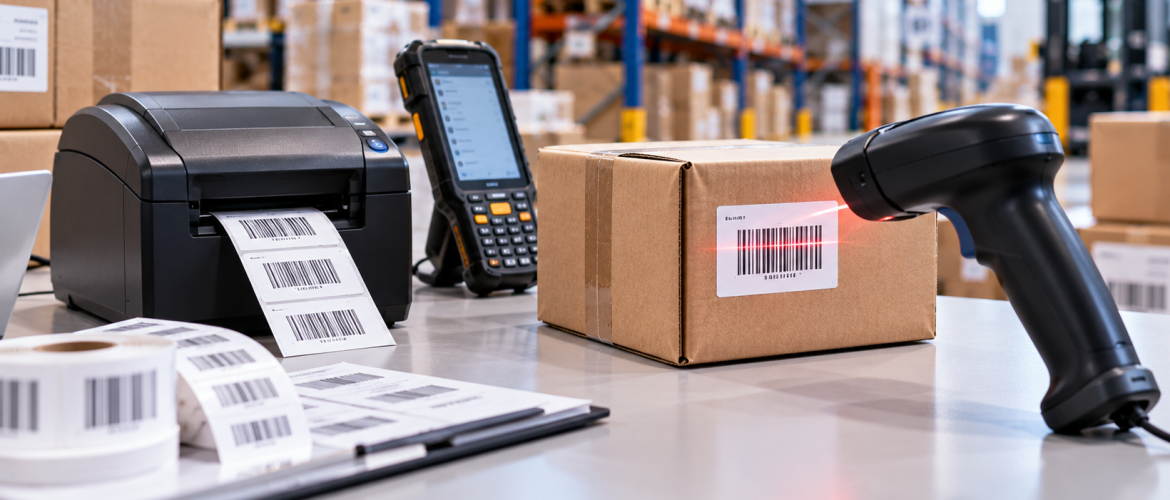
Introduction
Barcode technology has become an important part of inventory management, retail billing, warehouse operations, logistics and product identification.
Whenever an employee scans a product at a checkout counter, verifies a carton inside a warehouse or records an asset during a stock audit, a barcode scanner can help convert physical information into digital data within seconds.
For businesses searching for a Barcode Scanner Dubai, choosing the right scanner involves more than simply buying a device that can read a barcode.
Different applications require different scanning technologies. A retail checkout counter may require a simple handheld scanner, while a warehouse may need a rugged wireless scanner capable of reading barcodes from greater distances.
Businesses using QR codes or Data Matrix codes will normally require a 2D scanner rather than a traditional 1D device.
Understanding these differences can help businesses select equipment that supports faster and more accurate data capture.
Label Tech UAE supplies wired and wireless barcode scanners in Dubai, including 1D and 2D models, as part of its wider labeling and barcode solutions.
What Is a Barcode Scanner?
A barcode scanner is an electronic device that reads information contained inside a barcode and transfers that information to a computer, POS system, mobile device, warehouse system or other connected application.
In simple terms:
Barcode → Scanner → Business Software → Product or Inventory Record
When a barcode is scanned, the software can retrieve information such as:
- Product name
- SKU
- Price
- Serial number
- Batch number
- Stock location
- Asset number
- Shipment details
This reduces the need to enter long product codes manually.
Why Do Businesses Use Barcode Scanners?
Faster Data Entry
Employees can scan an existing barcode instead of typing a product or asset number.
Better Inventory Control
Scanning can help businesses record stock movements as products enter, move through or leave a facility.
Improved Product Identification
A barcode provides a unique machine-readable reference for a product or item.
Easier Stock Audits
Employees can scan products or assets during periodic stock-taking exercises.
Explore asset labels for equipment identification and asset-tracking applications.
Improved Checkout Processes
Retail businesses can use barcode scanners with POS systems to identify products and retrieve prices quickly.
Better Traceability
Barcodes can support batch, serial-number and shipment tracking when connected to suitable software.
1D vs 2D Barcode Scanners
What Is a 1D Barcode Scanner?
A 1D barcode scanner reads traditional linear barcodes made from vertical lines and spaces.
Common applications include retail product codes, inventory labels, warehouse labels, product identification and shipping applications.
Businesses working only with standard linear barcodes may find a 1D scanner sufficient.
What Is a 2D Barcode Scanner?
A 2D scanner can read two-dimensional codes such as QR codes, Data Matrix codes and PDF417.
Many 2D scanners can also read traditional 1D barcodes, which can make them practical for businesses that use several barcode formats.
Wired vs Wireless Barcode Scanners
Wired Barcode Scanners
A wired scanner connects directly to the computer or POS terminal.
It may be suitable for checkout counters, reception desks, fixed workstations and packing stations.
Advantages can include straightforward connectivity and no need to manage wireless charging during normal fixed-station use.
Wireless Barcode Scanners
Wireless models provide greater movement around the workplace.
They can be useful in warehouses, distribution centres, stock rooms, manufacturing facilities and large retail environments.
Workers can move between products instead of bringing each item to a fixed scanning station.
Barcode Scanners for Warehouses
Warehouse operations often require employees to move across racks, pallets and storage areas.
A warehouse barcode system can combine:
Aisle Board → Rack Label → Location Barcode → Product Barcode → Scanner → Warehouse System.
The scanner acts as the data-capture point connecting physical products with digital inventory records.
Warehouse managers should consider wireless range, ruggedness, scan distance, battery requirements, barcode quality, lighting conditions, drop resistance and compatibility with warehouse software.
Barcode scanners can also be combined with rack labels and aisle boards to create a more structured identification system.
Barcode Scanners for Retail Businesses
Retailers commonly use barcode scanners at checkout counters.
The process may look like:
Product Barcode → Scanner → POS Software → Product and Price.
Retail businesses should consider scanning speed, counter space, barcode formats, POS compatibility, ease of use and wired versus wireless operation.
Barcode Scanners for Logistics
Logistics operations can use barcode scanning at several stages, including goods receipt, sorting, storage, picking, packing, dispatch and delivery verification.
Scanning helps connect the physical package with the digital shipment record and can create better visibility throughout the movement of goods.
Barcode Scanners in Healthcare
Barcode technology can also be used in healthcare environments for applications such as inventory identification, laboratory samples, equipment tracking, medication identification and supply management.
The correct equipment should always be selected according to the organization’s operational and regulatory requirements.
How to Choose a Barcode Scanner in Dubai
1. Identify Your Barcode Type
Determine whether the scanner needs to read 1D barcodes, QR codes, Data Matrix or several formats.
2. Consider the Scanning Distance
A scanner used at a checkout counter has different requirements from one used to identify warehouse labels positioned several metres away.
3. Check the Working Environment
Consider dust, temperature, moisture, drop risk and indoor or outdoor use.
4. Decide Between Wired and Wireless
Fixed workstations may use wired scanners, while mobile warehouse teams may benefit from wireless units.
5. Confirm Software Compatibility
The scanner must work correctly with POS, ERP, inventory, warehouse management or asset management software.
6. Think About Daily Scan Volume
A scanner used occasionally has different requirements from equipment used continuously throughout a full shift.
7. Test the Actual Barcode
When possible, test the proposed scanner with the barcode labels used in the real operating environment.
Barcode Quality Matters Too
Even an advanced scanner may struggle with a badly designed or poorly printed barcode.
Barcode labels should have good print contrast, suitable barcode dimensions, sufficient quiet zones, clean printing, appropriate label material and correct positioning.
Damaged, faded or low-contrast codes may reduce scanning performance.
Explore barcode printing services for barcode label printing and identification requirements.
Barcode Scanner vs PDA Device
A barcode scanner and PDA device can both capture barcode information, but they perform different roles.
A standard barcode scanner primarily reads the barcode and sends the information to another system.
A handheld PDA or mobile computer can combine barcode scanning, display, processor, operating system, wireless connectivity, business applications and data storage.
You can explore handheld PDA devices for mobile barcode scanning, inventory management and warehouse data-capture applications.
Common Barcode Scanner Mistakes
- Choosing a 1D scanner for 2D codes.
- Ignoring the environment.
- Focusing only on price.
- Forgetting software compatibility.
- Ignoring barcode quality.
Why a Complete Barcoding System Matters
A barcode scanner is only one component of a wider identification system.
A complete solution can involve barcode scanners, barcode printers, barcode labels, barcode ribbons, handheld PDA devices, asset labels, rack labels, aisle boards and barcode printing software.
Businesses should ideally plan these components together to improve compatibility.
You can explore barcode and label printers for barcode-label requirements that complement scanning systems.
Choosing a Barcode Scanner Supplier in Dubai
Before selecting a supplier, consider product range, technical understanding, availability of 1D and 2D options, wired and wireless choices, related barcode equipment, support, product compatibility and the ability to recommend equipment according to the application.
Label Tech UAE provides various barcode scanner models and related barcode, printer and labeling solutions for businesses in Dubai and the wider UAE.
Conclusion
Choosing the right Barcode Scanner Dubai solution begins with understanding what needs to be scanned, where scanning will take place and how the captured information will be used.
Retail businesses may prioritize speed and POS compatibility. Warehouses may require wireless connectivity, longer scanning ranges and durable equipment.
Logistics and manufacturing businesses may need scanners that integrate into larger inventory and tracking workflows.
The best result comes from viewing the scanner as part of a complete identification system that also includes correctly designed barcodes, labels, printers and business software.
Label Tech UAE provides barcode scanners together with labeling and barcode-related equipment for businesses seeking a more integrated approach to data capture.
For barcode scanner specifications, product availability and business requirements, contact Label Tech UAE to discuss your scanning needs.
Frequently Asked Questions
What is a barcode scanner?
A barcode scanner is a device that reads machine-readable codes and sends the captured information to a connected computer, POS, inventory or business system.
Which barcode scanner is best for businesses in Dubai?
The best scanner depends on barcode type, operating environment, scanning distance, mobility and software compatibility. There is no single model that is best for every application.
Can a barcode scanner read QR codes?
A compatible 2D barcode scanner can generally read QR codes. Traditional 1D-only scanners normally cannot.
Is a wireless barcode scanner suitable for warehouses?
Yes. Wireless scanning can be useful where employees need to move between racks, cartons or storage locations.
What is the difference between a barcode scanner and PDA device?
A barcode scanner mainly captures barcode information. A PDA or mobile computer can combine barcode scanning with a display, software, wireless connectivity and mobile computing.
Can barcode scanners work with inventory software?
Many scanners can integrate with inventory, POS, ERP and warehouse applications, but compatibility should be confirmed before purchasing.
Does barcode label quality affect scanning?
Yes. Barcode size, contrast, printing quality, positioning and physical condition can all influence scanning performance.
Where can businesses source barcode scanners in Dubai?
Businesses can source barcode scanners and related barcoding equipment from specialist suppliers such as Label Tech UAE.AE.
